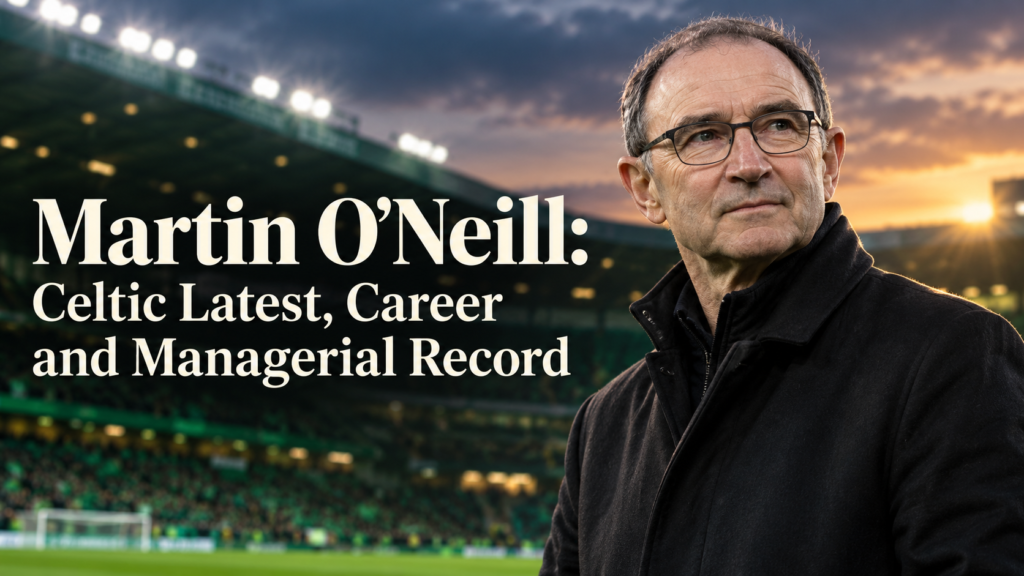
Martin O’Neill is a Northern Irish soccer manager and former midfielder whose career includes European Cup success with Nottingham Forest, trophy-winning spells at Leicester City and Celtic, and international management with the Republic of Ireland.
As of October 26, 2026, he is Celtic’s manager. The club confirmed his appointment for the 2026–27 season in June, announcing a one-year contract with an option for an additional year. That confirmed arrangement is important context when reading speculation about his future.
His story stretches well beyond the latest Celtic headline. O’Neill has experienced promotion battles, European finals and international tournaments, building a reputation through teams operating under very different expectations.
Martin O’Neill at a Glance
| Detail | Information |
|---|---|
| Full name | Martin Hugh Michael O’Neill |
| Date of birth | March 1, 1952 |
| Age | 74 as of October 26, 2026 |
| Birthplace | Kilrea, Northern Ireland |
| Playing position | Midfielder |
| Current role | Celtic manager |
| Best-known playing club | Nottingham Forest |
| International playing career | Northern Ireland |
| International managerial role | Republic of Ireland |
His nationality and international appointments sometimes cause confusion: O’Neill played for Northern Ireland but later managed the Republic of Ireland. These are separate national teams.
What Is Martin O’Neill’s Current Situation at Celtic?
His Appointment and Contract
O’Neill’s recent Celtic history involves several distinct appointments. He returned in October 2025 as interim manager following Brendan Rodgers’ departure, stepped aside when Wilfried Nancy arrived, and returned again in January 2026 after Nancy’s dismissal.
He subsequently led Celtic to the Scottish Premiership and Scottish Cup double. On June 11, 2026, Celtic confirmed that he would continue as manager under a one-year agreement with a further one-year option.
The distinction between an interim appointment and that later agreement matters. Describing him only as a temporary replacement overlooks the club’s subsequent decision.
Is Martin O’Neill Leaving Celtic?
Reports about a possible departure should be read according to their evidence. A pundit predicting that O’Neill will leave is different from the manager announcing his departure or Celtic confirming a replacement.
An October report about a potential summer exit relied on Mick Brown’s assessment. It did not establish an official departure announcement. The confirmed contract also includes an extension option, so its initial duration alone does not prove when O’Neill will leave.
Why His Recent Match Comments Matter
Following Celtic’s October victory over Hibs, O’Neill emphasized the difficulty of winning away after falling behind. His assessment distinguished the value of the result from the quality of the performance.
That is useful context for understanding managerial reactions. A comfortable victory may showcase attacking quality, while a difficult comeback can tell a coach more about concentration and resilience.
Martin O’Neill’s Early Life and Playing Career
What Was Martin O’Neill Like When He Was Young?
O’Neill grew up in Kilrea and played Gaelic football as well as association football. He attended St. Columb’s College and studied law at Queen’s University Belfast before committing to a professional playing career.
His early years included playing for Distillery, with whom he won the Irish Cup in 1971. Later that year, he moved to Nottingham Forest, beginning the association that would define his playing career.
This background helps explain why accounts of a young Martin O’Neill often extend beyond soccer. His route into the professional game involved different sporting traditions and a significant decision to leave university studies behind.
Martin O’Neill at Nottingham Forest
O’Neill played for Forest from 1971 to 1981, becoming part of the club’s extraordinary rise under Brian Clough. His time there included promotion, the 1977–78 First Division championship and European Cup-winning campaigns in 1979 and 1980.
Forest’s official account credits him with 371 appearances and 62 goals. Those are broader club totals; league-only records list 285 appearances and 48 goals. The difference reflects the competitions counted, rather than necessarily indicating an error.
That distinction matters when comparing player statistics. A record should identify whether it includes league games alone or appearances across competitions.
Northern Ireland and the World Cup
O’Neill earned 64 caps for Northern Ireland and captained the team at the 1982 World Cup. His international experience gave him a perspective he would later bring to management: tournament soccer involves limited preparation time and little room to recover from mistakes.
Martin O’Neill’s Teams Coached and Dates Joined
O’Neill began managing in non-league soccer before progressing to the Premier League, Celtic and international competition.
The timeline below uses joining months for established senior appointments. This avoids confusing announcement dates with first matches or administrative start dates, which can differ between databases.
| Team | Joined | Tenure |
|---|---|---|
| Grantham Town | 1987 | 1987–1989 |
| Shepshed Charterhouse | 1989 | 1989 |
| Wycombe Wanderers | February 1990 | 1990–1995 |
| Norwich City | June 1995 | 1995 |
| Leicester City | December 1995 | 1995–2000 |
| Celtic, first spell | June 2000 | 2000–2005 |
| Aston Villa | August 2006 | 2006–2010 |
| Sunderland | December 2011 | 2011–2013 |
| Republic of Ireland | November 2013 | 2013–2018 |
| Nottingham Forest | January 2019 | 2019 |
| Celtic, interim return | October 2025 | October–December 2025 |
| Celtic, subsequent return | January 2026 | Continued under June 2026 agreement |
The separate Celtic entries are intentional: they represent different appointments rather than uninterrupted service since his original arrival.
Wycombe and Leicester: Building His Reputation
At Wycombe, O’Neill helped take the club from non-league soccer into the Football League, followed by another promotion. Those achievements established his ability to develop a successful team without the resources of a major club.
After a short Norwich spell, he joined Leicester in December 1995. Promotion in 1996 was followed by League Cup victories in 1997 and 2000. Leicester also reached the 1999 final, making three appearances in four seasons.
The significance was sustained competitiveness: Leicester combined top-flight soccer with repeated opportunities to win silverware.
Aston Villa, Sunderland and International Management
O’Neill’s Aston Villa side finished sixth in the Premier League in three consecutive seasons and reached the 2010 League Cup final. Although Villa did not break into the Champions League places, that consistency was a substantial part of his record.
His Sunderland tenure ended in 2013 without comparable success. Later that year, he became Republic of Ireland manager.
The highlight was Euro 2016. Ireland defeated Italy through Robbie Brady’s late header to reach the round of 16, where France eliminated them. That campaign stands alongside his club achievements as an important managerial accomplishment.
He returned to Nottingham Forest as manager in January 2019, but the appointment lasted only until June. His standing as a celebrated former player did not translate into a long managerial tenure.
Why Celtic Is Central to His Managerial Legacy
The Original Spell: 2000–2005
O’Neill joined Celtic in June 2000 and won the domestic treble in his first season. His team added further league titles and reached the 2003 UEFA Cup final in Seville.
Celtic lost that final 3–2 to José Mourinho’s Porto. It was a runners-up finish, but reaching a European final demonstrated that the team’s ambitions extended beyond domestic competition.
His first spell ended with seven major trophies: three league titles, three Scottish Cups and one Scottish League Cup. He left in 2005 to help care for his wife, Geraldine, during her illness.
Comparing His Different Celtic Spells
His initial appointment gave him several seasons to build a team. The later interim returns demanded more immediate decisions and stability.
That difference makes direct comparisons difficult. A long-term manager can reshape a squad across transfer windows; an interim manager often works primarily with the players already available.
Celtic’s June 2026 announcement credited O’Neill with nine major honors overall following the latest league and Scottish Cup double. His later success therefore added to an established record rather than simply recalling it.
What Defines Martin O’Neill’s Management Style?
O’Neill’s teams have often been associated with competitiveness, strong player relationships and an emphasis on winning individual contests. Former Leicester defender Gerry Taggart’s account highlighted the determination and winning mentality of that side.
However, reducing his entire career to one formation would be misleading. Different squads and competitions required different solutions.
Leicester needed to establish itself in the Premier League while competing in cups. Celtic faced the expectation of domestic trophies alongside European tests. International management required him to prepare a national team during short training camps.
These jobs also demand different measures of success. A trophy count captures part of the story, but promotion, sustained league finishes and tournament qualification provide additional context. Comparing those outcomes is more informative than placing every appointment into a single career win percentage.
Martin O’Neill’s Health: What Has Been Confirmed?
On August 5, 2026, Celtic announced that O’Neill had undergone a small hospital procedure. The statement anticipated his release within a day or two.
On August 13, the club reported that he had returned to Lennoxtown following his short hospital stay. These dated updates establish the publicly confirmed sequence without requiring speculation about a diagnosis or long-term prognosis.
His return to work should not be treated as a complete medical assessment. Further health claims require a new statement from O’Neill or an authorized representative.
What Is Martin O’Neill’s Net Worth?
There is no reliably established public figure for Martin O’Neill’s net worth in the material reviewed. Online estimates should therefore be treated as unverified.
His career includes professional playing, management, broadcasting and publishing. Those activities help explain potential sources of income, but they do not reveal his assets, liabilities or investment results. His publisher confirms his autobiography and football background, not his personal wealth.
A salary figure, even when accurately reported, would not establish net worth on its own.
Conclusion
Martin O’Neill’s career connects Nottingham Forest’s European success with promotions, cup victories and international tournament management. His Celtic record remains central to that story, but Leicester, Wycombe and the Republic of Ireland also explain his standing. Understanding his current position requires the same care as assessing his career: distinguish confirmed appointments and achievements from predictions.
Frequently Asked Questions
How old is Martin O’Neill?
Martin O’Neill is 74 as of October 26, 2026. He was born on March 1, 1952, in Kilrea, Northern Ireland.
Is Martin O’Neill still Celtic manager?
Yes, as of October 26, 2026. Celtic confirmed his continued appointment in June on a one-year contract with an option for another year.
When did Martin O’Neill join Nottingham Forest?
He joined Forest as a player in 1971. He returned as manager on January 15, 2019, giving him two distinct roles in the club’s history.
Why did Martin O’Neill leave Celtic in 2005?
He stepped down to help care for his wife, Geraldine, during her illness. His departure followed five seasons in charge.
Did Martin O’Neill play for the Republic of Ireland?
No. He represented Northern Ireland as a player, earning 64 caps. He later managed the Republic of Ireland, including at Euro 2016.
Is Martin O’Neill’s net worth confirmed?
No independently verified figure was established in the sources reviewed. Published estimates should not be presented as confirmed personal wealth.
You May Also Read: Wayne Gretzky and Miguel Patricio